



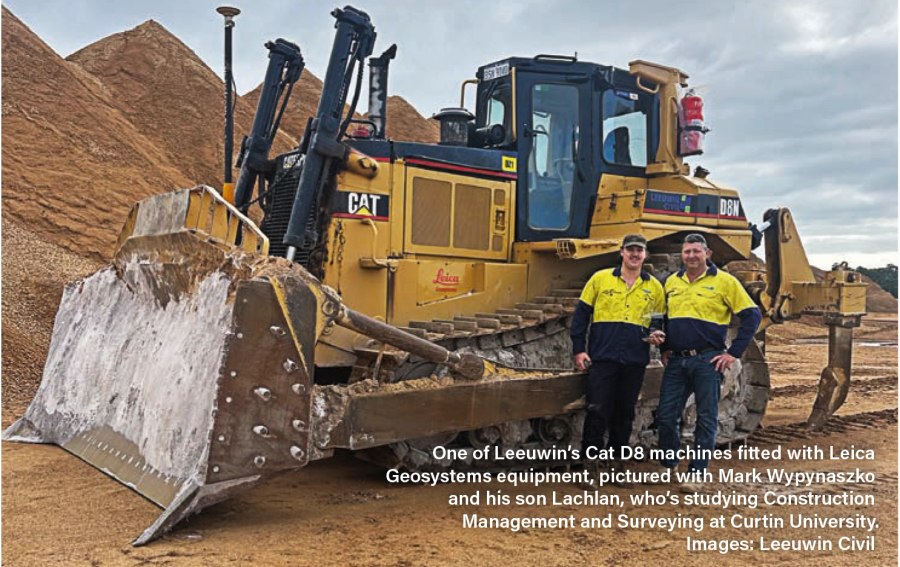
It goes without saying that civil projects need to be completed to specification, on time, and with minimal rework.
For Leeuwin Civil, working to that ethos has ensured a solid reputation for more than two decades.
Based in Busselton and servicing the wider South West region of WA, the business has grown into one of the region’s larger privately operated civil contractors, specialising in subdivision development, bulk earthworks, road construction, and drainage infrastructure — critical foundations for the region’s expanding residential and commercial developments.
Alongside contracting services, the business also operates licensed gravel and sand pits supplying materials to local governments, developers, and private clients.
As director Mark Wypynaszko said: “We try to keep things simple — do the job properly, meet the spec, and stand behind our work.”
He said Leeuwin Civil was established to meet growing demand for capable, locallybased civil contractors in an area experiencing sustained growth through residential development and infrastructure expansion.
“Twenty years in business reflects steady growth, long-term relationships, and a consistent focus on delivering what we commit to,” Mark said. “Today, the company employs more than 80 staff across operations, project management, and administration. The workforce includes a large contingent of experienced machine operators, supervisors, and technical personnel, supported by administrative and project delivery teams.”
Operational leadership has also played a key role in the company’s development. Chief Operating Officer Dave Evans has helped strengthen operational systems and elevate project delivery standards over the past decade.
“A big part of our growth over the past 10 years has been driven by Dave,” Mark said. “He’s played a key role in improving how we operate day-to-day and lifting our project delivery standards.”
The digital dawn
While experienced crews remain central to Leeuwin Civil’s success, technology now plays an equally critical role in its project workflows.
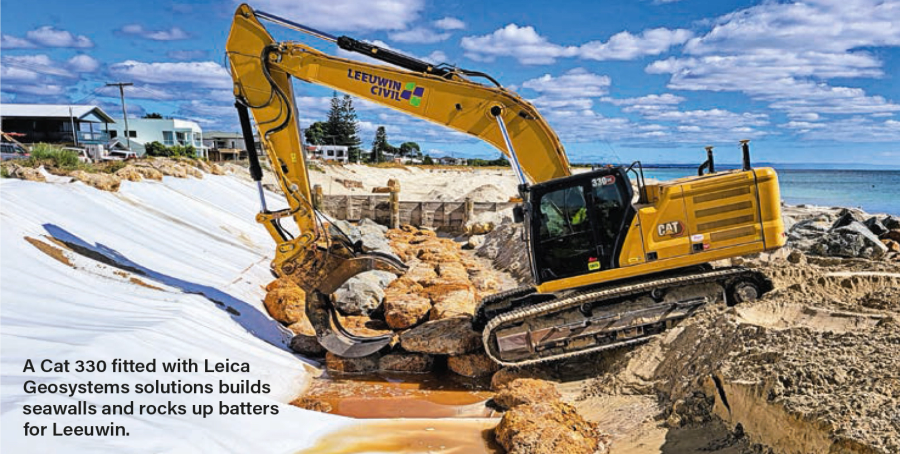
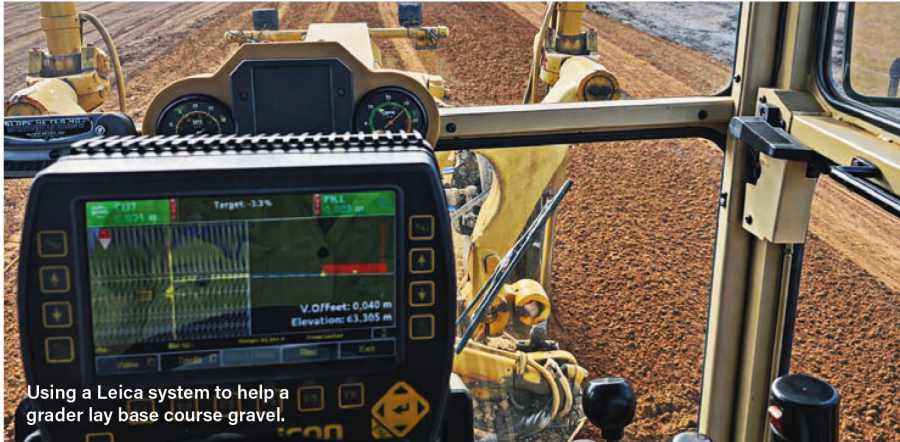
Across the company’s fleet, spatial technology has become embedded in daily operations. Machine control systems, rover kits and total stations allow operators to work from digital site models, improving accuracy and reducing the need for traditional pegging.
“For us, spatial technology is just part of how we work now,” Mark said.
Leeuwin Civil currently operates about 30 machines equipped with machine control systems across a range of equipment types, including graders, excavators, dozers, scrapers and wheel loaders. Supporting this fleet are eight supervisor rover kits and five total stations used for site set-out and high-precision grader control.
Having that level of integration across the fleet means crews are working from the same digital information, reducing mistakes and keeping everyone aligned.
“Subdivision and road construction demand extremely tight tolerances. Even minor deviations in grade or alignment can lead to material overuse, rework, or compliance issues during engineering inspections,” Mark said.
Spatial technology addresses these risks by enabling millimetre-level accuracy throughout the construction process.
“It affects trimming accuracy, material quantities, and compliance with engineering specifications,” Mark said.
“For Leeuwin Civil, the decision to standardise machine control across the fleet has delivered measurable improvements in productivity and efficiency. Trim operations are faster, rework has been reduced, and operators are able to complete grading tasks with greater confidence.
“The benefits are particularly noticeable on subdivision projects where tight tolerances and fast construction schedules are the norm.
“It gives our clients — and us — greater confidence that what’s being built matches the design.”
Technology in the field
The company’s spatial technology ecosystem includes several key components used across daily operations:
- GNSS machine control systems: Installed across graders, dozers, excavators, scrapers and wheel loaders, these systems provide real-time positioning and automated grade control based on digital terrain models.
- RTK GPS base and rover units: Supervisor rover kits allow engineers and supervisors to perform set-out tasks, check grades and verify as-constructed surfaces.
- Total station systems: Total stations are used for high-accuracy set-out and precision grader control, particularly where satellite visibility may be limited.
- Field controllers and software: These systems enable operators and supervisors to manage and verify digital design data on site.
The result is a digital workflow that links design files to the construction equipment performing the work.
“These systems allow our operators to work directly from digital models rather than relying solely on traditional pegging,” Mark said.
“One thing that has really impressed us is how well the Leica equipment has held up.
“We still have systems that are around 14 years old — some removed from machines we traded due to high hours and then fitted straight onto new ones.
“Given we offload excavators at around 12,000 hours, some of these systems have done close to 25,000 hours and are still performing reliably.
“Most of our fleet now runs the latest MCP80 with MC1 software, but we still have a few older ICP42 units in service with 25,000-plus hours on them, and they continue to perform well. “When you compare the original cost of the system to the service life you expect, it really affects your bottom line at year-end, and that reliability has certainly helped us build a strong business.”
A long-term partnership
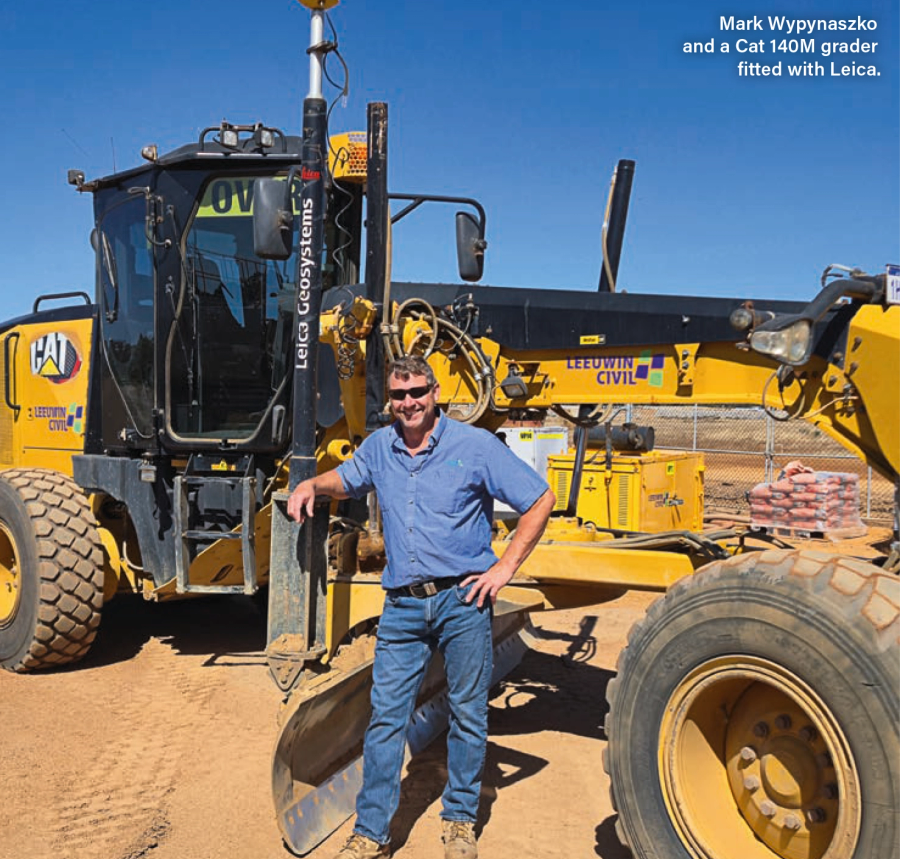
Behind Leeuwin Civil’s spatial technology infrastructure is a long-standing relationship with Australian distributor C.R. Kennedy.
The connection dates back to 2014, when the company was experiencing reliability issues with its first machine control grader system.
“It had only been installed for about six months, but we were dealing with erratic blade movement and the original dealer couldn’t resolve the issue,” Mark said.
“A fellow contractor recommended contacting C.R. Kennedy, which assessed the installation and proposed a replacement solution using equipment from Leica Geosystems. “We decided to remove the existing system and install a Leica solution instead. The changeover happened quickly and we were back operating confidently within days.”
That experience marked the beginning of a partnership that has now spanned more than a decade.
Leeuwin Civil works closely with the Perth branch of C.R. Kennedy, particularly with representatives Jeff Hugo and Dean Saville, along with the wider technical support team.
“The support we receive from C.R. Kennedy is a big part of why the relationship has lasted,” Mark said.
“Training and commissioning support are provided as new systems are installed, ensuring operators and supervisors are comfortable using the equipment. However, much of the day-to-day assistance occurs through phone-based technical support.
“Most issues — around 90 per cent — are resolved over the phone, often directly with Dean. Being able to talk through a problem and fix it immediately makes a real difference on site.” This accessibility has helped build long-term trust between the contractor and supplier. “They’ve never let us down,” Mark said.
Looking ahead As infrastructure projects grow more complex and engineering standards continue to tighten, digital construction technologies are becoming increasingly essential for civil contractors.
For Leeuwin Civil, continued investment in spatial systems is a central part of the company’s future.
“Spatial technology isn’t optional anymore — it’s fundamental,” Mark said. “With our fleet already heavily integrated with machine control and survey technology, we expect further expansion of our digital capabilities as new projects emerge across the South West.
“C.R. Kennedy has been part of our journey for over 10 years. We expect that relationship to continue well into the future.”
As seen in Earthmoving Equipment Magazine
